SuSNG: Sustainable Natural Gas
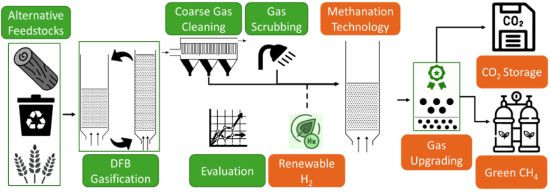
The main research objective of the SuSNG project is to demonstrate sorption enhanced gasification (SEG) in a dual-bed fluidized bed (DFB) for the production of an H2-rich product gas that can be used directly as a reactant for methanation. In addition, the project focuses on the use of a wide range of biogenic waste resources and the practical and simulated representation of a process chain for the production of grid-quality, sustainable natural gas.
The methodology is based on process design through the selection of suitable biogenic feedstocks and a sorption-active bed material. The use of temperature swing adsorption to purify the product gas to synthesis gas quality is being investigated by feeding it with real gas from the 1 MW aDFB plant of the Syngas Platform Vienna and using model gas and tar components. The project is supported by scientific cooperation with the Technical University and the University of Natural Resources and Life Sciences in Vienna on topics related to process simulation and syngas methanation.
SuSNG
Preliminary results
The research work and results of the first project year in SuSNG mainly provided insights into the design and implementation of SEG operation in the secondary fluidized bed.
The known SEG limit parameters were used as critical variables for operation in large-scale plants. The control of process temperatures and the circulation of sorption-active bed material are critical parameters in operation and process control. Calcium silicate was selected as the best possible bed material option for SEG operation in economic and technical terms. Abrasion tests on various materials with different grain size distributions, purity levels, and origins formed the basis for the decision on which material to use for the demonstration campaign.
The influence of feedstock qualities on SEG operation was assessed using feedstock modeling. The use of moist feedstock helps to keep the gas production temperature as low as possible (below 700°C) in order to promote CO2 sorption. Critical factors for gas purification were the expected values for NH3 and H2S emissions. The findings of the preliminary investigations led to the selection of two wood-based feedstocks for the comparative demonstration operation: forest residues (with >40 wt% moisture) and wood chips (with ~15 wt% moisture). The influence of the process and feedstock parameters on the operating mode can thus be represented and evaluated in real operation.
The development of a suitable process simulation interface for displaying the entire process chain was initiated in parallel with the preparations for the research campaign. The process chain focuses on SEG operation but is intended to serve as a basis for comparison with other methods for increasing the H2 content in synthesis gas and to demonstrate the possibility of CO2 sinks in the process chain.
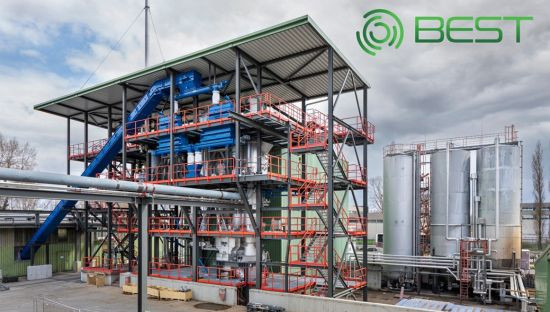
At the end of the first project year (early March 2026), the aDFB gas production system will be operated in SEG mode at the Syngas Platform Vienna for several days.
Syngas Platform Vienna
Outlook
Following completion of the biggest milestone, i.e., demonstration of the SEG process at the Syngas Platform Vienna, the outlook for the second year of the project focuses on completing the process chain through subsequent methanation and data evaluation. A complete evaluation of the efficiency and yield parameters of the demonstration plant will be carried out in the first few months of the second project year. After measuring the gas quality, the bottled synthesis gas will be made available for further processing by means of fluidized bed methanation. Based on the balance sheet of the entire process chain, conclusions will be drawn about the CO2 reduction potential and the substitution of fossil natural gas.
Start of project
2025-02-01 (ongoing)
Supported by
COMET, FFG
Projektpartner
.jpg)

Contact
Miriam HUBER
miriam.huber@best-research.eu
Area Management
Matthias Kuba
matthias.kuba@best-research.eu

Gerald Weber
gerald.weber@best-research.eu