Control Engineering Process Optimisation of Sawdust Drying in Wood Pellet Production
The drying of sawdust represents the most energy-intensive process step in the wood pellet production chain. For this purpose, so-called belt dryer systems are used, in which the sawdust is applied to a permeable belt and passes through a drying zone through which hot air flows. The efficiency of the process depends heavily on the precision with which a certain, constant target moisture content is achieved after drying. If the sawdust is still too moist, the final product does not meet legal requirements. Overdrying, on the other hand, leads to losses in material throughput as well as unnecessary energy and water consumption, since the sawdust must be re-moistened for further processing.
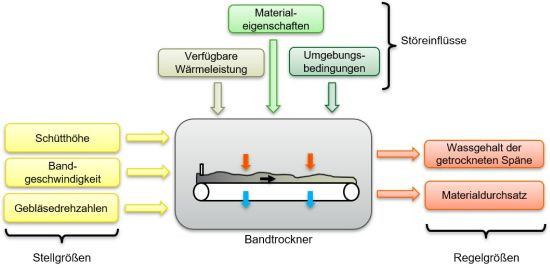
In a collaboration between BEST – Bioenergy and Sustainable Technologies GmbH and Salzburg Pellets GmbH as part of the COMET program, an investigation was conducted into how the operation of such drying processes can be improved using suitable control algorithms. The focus was on the development of model-based methods that specifically account for physical relationships and, in this way, compensate for external disturbances such as fluctuations in raw material moisture content or available thermal output.
The results of a six-month validation period at the belt dryer of Salzburg Pellets GmbH are impressive:
- Reduction of moisture content fluctuations by 25% (standard deviation) compared to standard control
- Increase in target moisture content after drying by 0.5 percentage points while maintaining pellet quality, i.e., less overdrying required
- Average efficiency gain of 2.42% in the drying process, i.e., 2.42% less energy input for the same production volume
- Higher material throughput
- Significant reduction in the need for manual control interventions
- Annual CO₂ savings of 220t
 The use of the developed control algorithms demonstrably increased the process stability of the investigated belt dryer, thereby enabling more economical and environmentally friendly plant operation.
(Helmut Niederwieser)
2026-08-28